
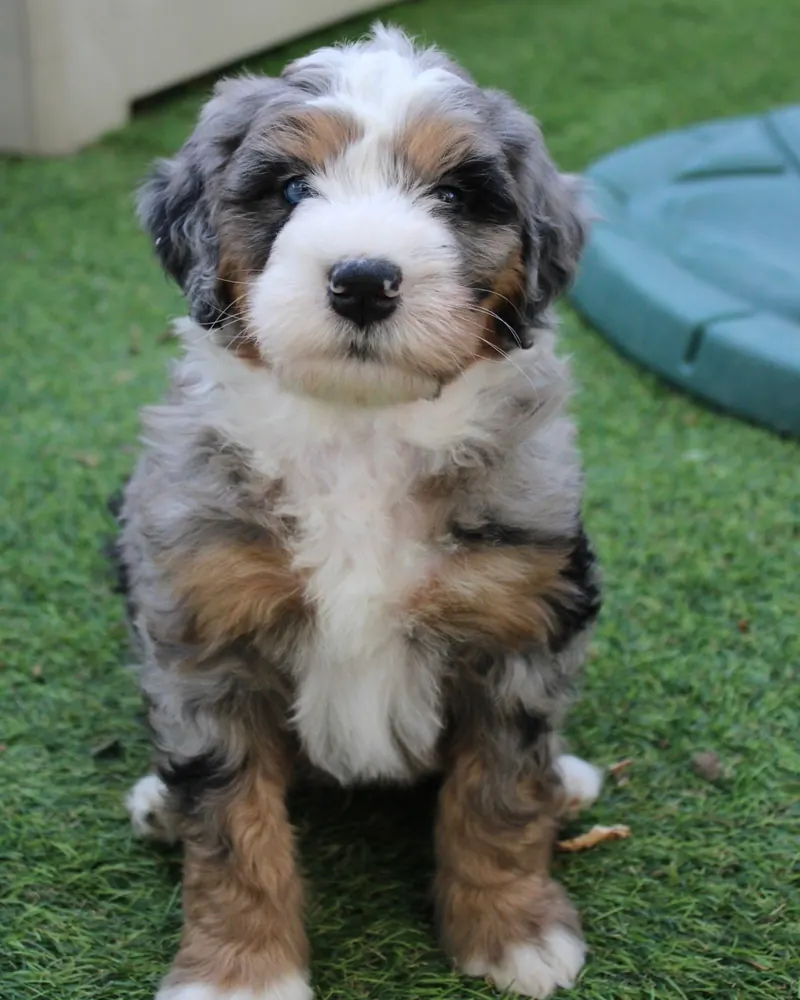
Bernedoodle Sizes
Standard Bernedoodle Size and Care
The standard Bernedoodle is the original and the largest of the sizes: a Bernese Mountain Dog crossed with a Standard Poodle. Adults commonly weigh about 50 to 90 pounds, which puts them in the large dog bracket.
Below you will find the size to expect, what a dog this big asks of your home and your time, the health points that matter more in big dogs, and the reasons some families choose a standard over a smaller Bernedoodle. These sizes are breeder conventions, because the Bernedoodle is not a recognized breed, so ranges differ and no adult size is guaranteed.
How big is a standard Bernedoodle?
A standard typically weighs about 50 to 90 pounds and stands around 23 to 29 inches at the shoulder. Males tend to be at the upper end and females lower.
The parents explain the size. The AKC says the Standard Poodle is over 15 inches tall, and the Bernese Mountain Dog is about 23 to 27.5 inches and 70 to 115 pounds depending on sex. Two large parents give a large puppy, and the result is often sturdier than a mini but lighter than a pure Bernese. For the standard next to the smaller versions, see the full grown size chart.
When do standard Bernedoodles stop growing?
Large dogs mature slowly. A standard usually reaches adult height around 12 to 15 months, but the chest, bone and muscle keep developing until roughly 18 to 24 months. You may have a lanky, awkward teenager for a year.
Expect the in-between stages to look odd. A 6 month old standard may already weigh 40 to 55 pounds, with big paws and a lot of energy but not much coordination. Calm, consistent training in those months pays off later, because a mistake is harder to fix once the dog weighs 80 pounds.
This has practical effects. Large puppies grow fastest while their joints are still soft, so avoid long runs, hard jumping and slick floors during that time. Feed a diet suited to large breed puppies, since overfeeding and rapid weight gain are linked to joint problems in big dogs. The Bernedoodle food guide covers the details.
How much space and exercise does a standard Bernedoodle need?
A standard does best in a home with some room to move, ideally with a fenced yard, though many live happily in houses without one if walks are reliable. Plan on an hour or more of activity a day for a healthy adult: brisk walks, a hike, swimming, fetch or training games.
Daily life with a dog this size has other costs. Larger food bills, larger beds, a crate that fits a 70 pound dog and a car with room in the back are all part of it. Leash manners matter too, since a strong dog that pulls is hard to hold. Start loose-leash training in the first few months. Teaching a calm greeting early matters as well, since a standard that jumps up at 80 pounds can knock over a child or an older relative.
What health problems affect large Bernedoodles?
Any dog can have health problems, and the parent breeds each carry their own. Large dogs share a few concerns, and a prospective owner should know them.
- Hip and elbow dysplasia: Joints that form incorrectly and wear down over time. Both are reported in the Bernese Mountain Dog. Keeping a dog lean is one of the best ways to protect the joints.
- Bloat: Gastric dilatation and volvulus, where the stomach fills with gas and may twist. It is a veterinary emergency and affects deep-chested dogs. Warning signs include a swollen belly, drooling, restlessness and unproductive retching. Slower meals and no hard exercise right after eating are the standard advice. Ask your vet about preventive surgery.
- Shorter lifespan: Larger dogs tend to live fewer years than small ones.
The Bernedoodle health guide goes through the wider list.
Why do some families choose a standard Bernedoodle?
One reason is steadiness. Large dogs often mature into a settled adult, and the Bernese side adds a gentle, people-loving streak that many owners value in a family dog. A standard may also appeal if you want a dog that can go on long walks and hikes without tiring early.
People who pick a standard usually want a dog with presence. It is a good size for hiking and for families with older children, who will not knock over a 70 pound dog. Many owners like the calm that often comes with a bigger frame, and a large dog can look more like the Bernese parent, with a deeper chest and a thick coat.
A standard also suits someone who has owned large dogs before and is comfortable lifting, bathing and handling one. If you are not sure, picture a wet, muddy 75 pound dog after a rainy walk. If that is fine with you, the size is probably right.
Does a standard Bernedoodle need more grooming?
More coat means more brushing time and larger groomer bills. A standard needs a thorough brush a few times a week, with clipping every 6 to 8 weeks if you keep the coat short. Wavy and curly coats mat behind the ears, under the legs and along the collar line. The grooming guide shows how to keep on top of it.
Standard or mini: which should you pick?
Choose a standard if you have space, strength and a love of big dogs. Choose a smaller size if you live in a rental with weight limits, travel often or want a dog that is easy to lift. The mini Bernedoodle is the most popular middle choice. When you are ready to look at puppies, see the available puppies.
Quick Answers
01How much does a full grown standard Bernedoodle weigh?
Commonly about 50 to 90 pounds, depending on parent size and sex. That is a breeder convention rather than a breed standard, and no puppy comes with a promised adult weight.
02Is a standard Bernedoodle a large breed?
It is a large dog, though the Bernedoodle itself is not a recognized breed. Plan for the food, space and handling of a large dog.
03Do standard Bernedoodles bark a lot?
They are watchful and may bark at visitors, but training and enough exercise keep it manageable. Their deep bark can seem louder than a small dog's.
04Can a standard Bernedoodle live in an apartment?
It is possible with reliable daily exercise and a building that allows large dogs, but most standards are happier with more room.
05How long do standard Bernedoodles live?
Larger dogs generally live shorter lives than small ones. The lifespan guide explains what influences it.
When You Are Ready
Looking for a Standard Bernedoodle?
See the puppies available now, or ask us anything about size and growth.