
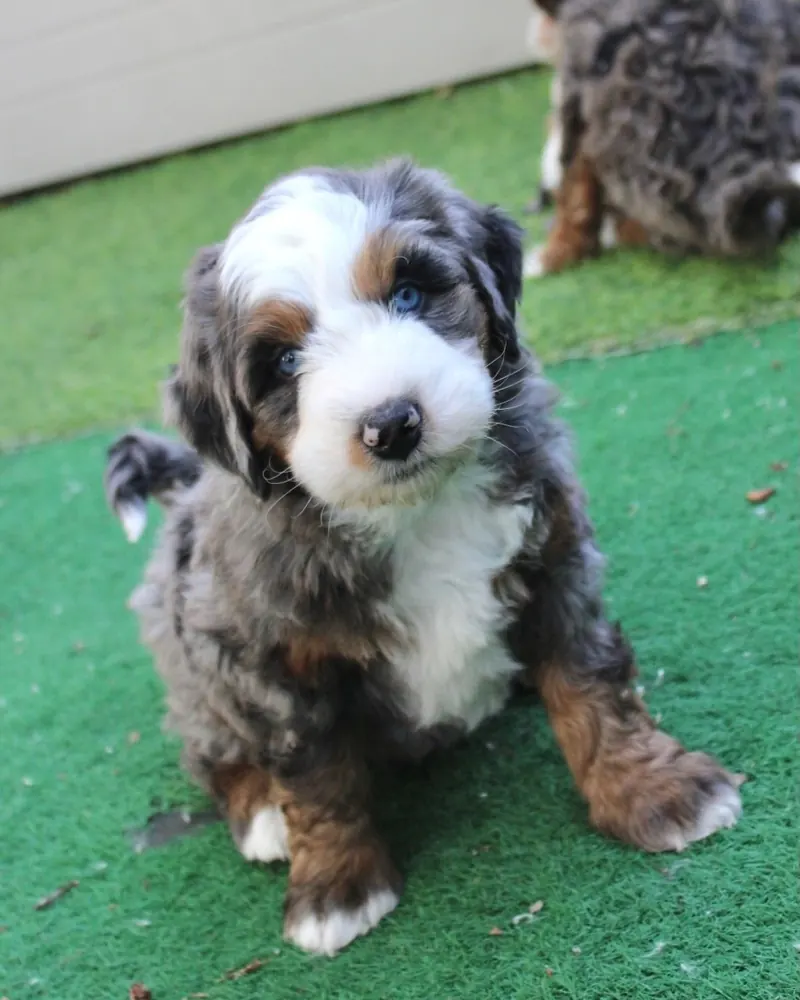
Bernedoodle Sizes
Mini Bernedoodle Puppies and Adult Size
A mini Bernedoodle is a Bernese Mountain Dog mixed with a Miniature Poodle, and it is the size most families end up choosing. Most adults land between 25 and 49 pounds, which is sturdy enough for hikes and small enough for a sofa.
This page covers how big a full grown mini Bernedoodle gets, a growth table by age, how minis are bred, what the coat does, and whether one suits your home. Bernedoodle sizes are breeder conventions, not breed standards, so treat every number here as a range rather than a promise.
Mini Bernedoodles Available Now
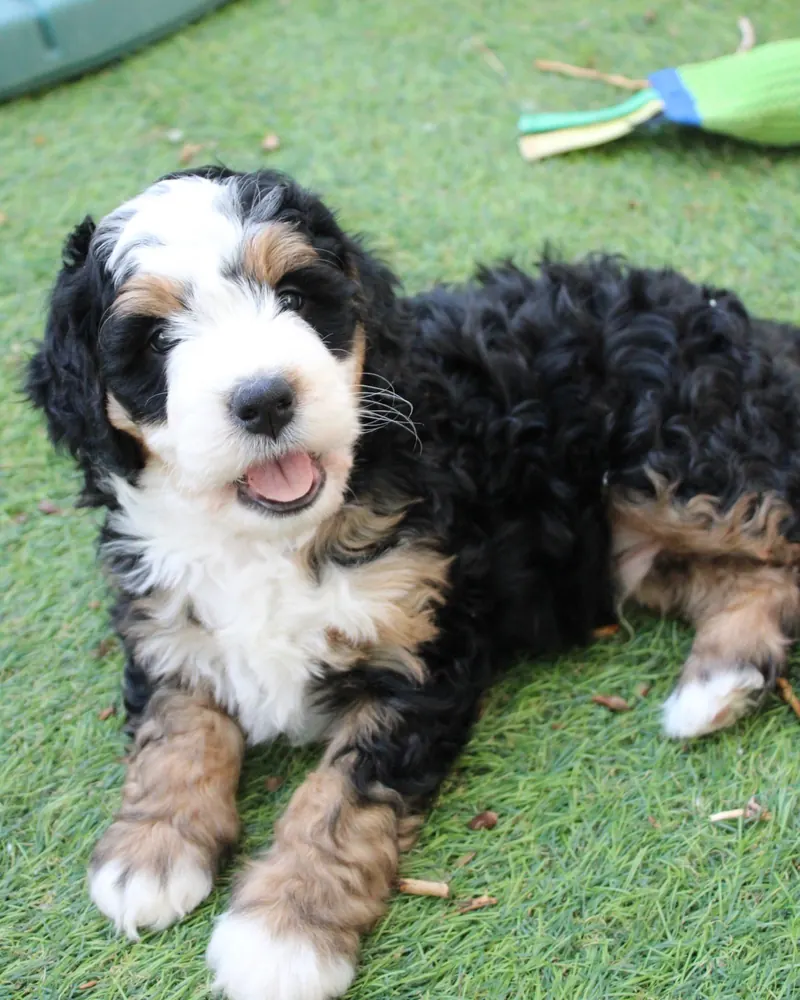
How big does a mini Bernedoodle get?
Most full grown mini Bernedoodles weigh about 25 to 49 pounds and stand roughly 18 to 22 inches tall at the shoulder. That is a wide spread, and it is wide for a reason: the two parent breeds are very different in size.
A Bernese Mountain Dog is a big dog. According to the AKC, males stand about 25 to 27.5 inches and weigh about 80 to 115 pounds, and females stand about 23 to 26 inches and weigh about 70 to 95 pounds. The AKC lists the Miniature Poodle at 10 to 15 inches. A puppy can inherit anything between those two, so a mini at the top of the range may look like a small version of a Bernese, while one at the bottom may look closer to a Poodle.
The Bernedoodle is not a recognized breed, and the size names are labels that breeders agree on among themselves. Ranges differ from one breeder to the next, and no one can promise the exact adult size of a puppy. A parent's size is a useful clue, not a guarantee. For the other sizes side by side, see the Bernedoodle size and weight chart.
How much does a mini Bernedoodle weigh at each age?
Puppies grow fast in the first six months and then slow down. The table below is a rough guide for a mini that will finish somewhere in the middle of the range. Your puppy may run ahead of it or behind it.
| Age | Typical weight | What to expect |
|---|---|---|
| 8 weeks | 6 to 12 pounds | Small, round and clumsy |
| 3 months | 12 to 20 pounds | Fast growth, legs lengthening |
| 6 months | 20 to 35 pounds | Close to adult height, still lean |
| 9 months | 25 to 42 pounds | Adolescent, filling out |
| 12 months | 25 to 49 pounds | Nearly full size |
A common rule of thumb is to double the weight at 4 months to guess the adult weight. It is only a rough estimate, and it works less well for mixed breeds than for purebreds, so use it for curiosity and not for planning.
When do mini Bernedoodles stop growing?
Most minis reach their adult height somewhere around 9 to 12 months. After that they keep filling out, with a deeper chest and heavier bone, until about 18 months to 2 years. A dog that looks lanky at 10 months is often a different shape by its second birthday.
That matters when you weigh the dog, and it is also why a photo of a puppy at 6 months says little about the finished dog. Another thing to remember is that a mini's coat changes too: the puppy fluff of the first months is often replaced by a thicker, wavier or curlier adult coat between 6 and 12 months, and it can mat badly during that switch, so brush daily through that stretch.
On the scale, if your vet says your dog is slim at a year old, that may be normal. Ask your vet to score body condition, since the ribs should be easy to feel without being sharp, and keep food portions steady while the body finishes developing.
How is a mini Bernedoodle bred?
The most direct route is a Bernese Mountain Dog bred to a Miniature Poodle. Because the Bernese is so much larger than the Miniature Poodle, puppies in the same litter can end up noticeably different in size. Many mini Bernedoodles are also bred from later generations, such as a mini Bernedoodle paired with a Poodle or with another Bernedoodle. That is why breeders talk about generation whenever they talk about size.
Each step changes the odds of coat type and size. The guide to Bernedoodle generations explains F1, F1b, F2 and multigen in plain terms, and what a Bernedoodle is covers the basics of the cross.
What is the difference between an F1 and an F1b mini Bernedoodle?
An F1 mini is a first cross: half Bernese and half Poodle. Coats vary a lot in this group, from loose waves to straighter, shaggier hair, and some shed lightly. An F1b mini is an F1 bred back to a Poodle, so it carries more Poodle in its makeup. Those coats tend to be curlier and more likely to hold in loose hair, but genes mix unpredictably and a coat can surprise you in either group.
- F1: half Bernese, half Poodle, with the widest range of coat types.
- F1b: about three quarters Poodle, with a tendency toward curls and a lower chance of shedding.
- Either way: expect regular brushing and haircuts, and note that no coat is guaranteed allergy safe.
The shedding guide, do Bernedoodles shed, goes further on coats and allergies.
How much exercise does a mini Bernedoodle need?
Plan on about an hour of activity a day for an adult, split into a walk or two plus play. Some days the dog will want more and some days less, so watch the dog rather than the clock. Minis are intelligent and often eager to learn, so a few short training games count as exercise for their minds as well as their legs. Without enough to do, a bored mini will invent its own jobs, which usually means chewing or barking.
Puppies need less running and more short sessions. Hard, repeated jumping and long runs on hard ground are best avoided until the joints have matured. Temperament varies even within a litter; the Bernedoodle temperament guide describes the usual Bernese calm and Poodle bounce.
Is a mini Bernedoodle good for an apartment?
It can be, as long as the daily walks happen. A mini at 30 or 40 pounds is calm indoors once its exercise is done, and it does not need a yard to be happy. The things that decide whether apartment life works are the building rules, stairs and noise.
- Check weight limits in your lease, since some buildings cap dogs at 25 or 35 pounds.
- Teach the puppy to be alone for short stretches early, because Bernedoodles bond closely to their people.
- Expect to walk at least twice a day, in all weather.
- Keep up with brushing, as loose hair and mats build up quickly in a small space.
How long do mini Bernedoodles live?
Smaller dogs generally live longer than large ones, which is a pattern vets see across many breeds. The Bernese Mountain Dog is one of the shorter lived breeds, with the AKC giving a typical span of about 7 to 10 years, while Miniature Poodles commonly live well into their teens. A mini Bernedoodle may fall between the two, and many owners hope for a longer life than a Bernese would have, but no one can promise it.
Weight control, dental care, regular vet visits and good food all help. The Bernedoodle lifespan guide has more, and the health guide lists conditions worth knowing about. When you are ready to meet puppies, the available puppies page shows who is ready now.
Quick Answers
01How big is a full grown mini Bernedoodle?
Most adults weigh about 25 to 49 pounds and stand roughly 18 to 22 inches at the shoulder. The range is wide because the cross can lean toward either parent breed, and no one can promise an exact adult size.
02Is a mini Bernedoodle the same as a micro?
No. A micro is a smaller label used for the low end of the mini range or below it. Neither word is an official standard, so the cutoff depends on who is using it. See the micro Bernedoodle page.
03Do mini Bernedoodles bark a lot?
They are alert and will bark at visitors or noises, but a well exercised, trained mini is not usually a constant barker. Boredom and being left alone for long hours are the common causes of excess barking.
04Are mini Bernedoodles easy to train?
Many are, because the Poodle side is intelligent and the Bernese side is eager to please. Short, positive sessions and early socialization work best. Expect some adolescent silliness at 6 to 12 months.
05Is a mini better than a standard Bernedoodle?
It depends on your space and strength. A mini is easier to lift, travel with and feed, while a standard Bernedoodle is a larger, heavier dog that needs more room and exercise.
When You Are Ready
Looking for a Mini Bernedoodle?
See the puppies available now, or ask us anything about size and growth.