Bernedoodle Guide
Bernedoodle Generations: F1, F1b, F2 and Multigen
Scroll through any list of Bernedoodle puppies and you will meet a string of letters: F1, F1b, F1bb, F2, F2b, multigen. They are shorthand for how a puppy's parents are related to the two original breeds, and they are the quickest way to compare litters.
The labels come from the world of crossbreeding and genetics, and breeders apply them with some freedom, so they describe a likely pattern and never a certainty. Here is what each one means, what it tends to do for the coat, and how F1 and F1b compare.
What do the letters and numbers in Bernedoodle generations mean?
The "F" stands for filial, a term borrowed from genetics for the offspring generation. The number counts how many steps removed a puppy is from the original purebred cross. A lowercase "b" means "backcross": a parent was bred back to one of the original breeds, almost always the Poodle.
Two things to keep in mind. These are conventions used by breeders, not rules enforced by a registry, so ask a breeder to explain exactly which dogs are the parents. And the shorthand predicts averages across many litters. A puppy from one litter can look nothing like the typical F1 or F1b described below.
What is an F1 Bernedoodle?
An F1 is the first cross: a purebred Bernese Mountain Dog bred to a purebred Poodle, giving a puppy that is genetically half and half. F1 puppies are the most direct blend of the two breeds. Their coats are usually wavy, sometimes with loose curl, and many are described as having a straighter, shaggier look than curlier generations.
F1 Bernedoodles often shed more than backcrossed dogs, and the amount is less predictable. They can be a good fit for someone who wants the Bernese look and a softer, more natural coat and who does not need the lowest possible shedding. Note that two puppies in one F1 litter can differ noticeably: one may be wavy and light shedding while a sibling has a flatter, shaggier coat. Size in an F1 depends on the Poodle parent, so an F1 standard and an F1 mini are very different dogs. Many owners enjoy the F1 for its relaxed, natural look and its closeness to the Bernese side.
What is an F1b Bernedoodle?
An F1b is an F1 Bernedoodle bred back to a Poodle (or occasionally to a Bernese, though that is rare in practice). The puppy is then roughly 75 percent Poodle and 25 percent Bernese on average. The extra Poodle usually means a curlier or tighter wave and, more often, a coat that sheds little.
Many people want an F1b for that reason. The tradeoff is a coat that needs more regular brushing to stay free of mats, and some of the Bernese look, such as the straighter, silkier outer coat, is more diluted. F1b is one of the most requested labels in the cross, largely because of the coat. An F1b mini, for example, pairs a mini Bernedoodle with a miniature Poodle, and its adult size follows the smaller parent. The guide to mini Bernedoodles covers that size.
How does an F1 compare with an F1b Bernedoodle?
Here is a side-by-side look at the typical differences. Remember these describe tendencies, not rules.
| F1 | F1b | |
|---|---|---|
| Parentage | Bernese x Poodle | F1 Bernedoodle x Poodle |
| Genetic mix | About 50 percent each | About 75 percent Poodle, 25 percent Bernese |
| Typical coat | Wavy, sometimes straighter | Wavy to curly |
| Shedding | Light to moderate, less predictable | Light, more predictable |
| Grooming | Regular brushing | Regular brushing, more matting risk |
If shedding is your first concern, an F1b is the usual choice. If you like a laid-back, shaggier coat and the look of the Bernese, an F1 may suit you better. Either way, meeting the parents and seeing their coats is the most reliable preview.
What is an F1bb Bernedoodle?
An F1bb comes from breeding an F1b back to a Poodle yet again, so the puppy is about 87.5 percent Poodle. These dogs usually have tight curls, a very Poodle-like coat and the least shedding of the labels here. The Bernese contribution is small, so the dog may look and feel more like a Poodle, including in the shape of the head and the lighter build.
Because the Bernese share is so low, the sturdy, calm Bernese temperament may also be less strongly present, and the tricolor pattern is rarer, since it comes from the Bernese side. Some F1bb dogs look much like a Poodle in a new coat color. Temperament remains individual, though, and a good match depends more on the dogs themselves than on the number.
What are F2, F2b and multigen Bernedoodles?
An F2 comes from breeding two F1 Bernedoodles together, which gives about half Bernese and half Poodle again but with more spread in the litter, since each puppy draws a different mix from its parents. An F2b is an F2 bred back to a Poodle, and it tends to behave like an F1b in coat terms.
Multigen, short for multigenerational, means that both parents are Bernedoodles from earlier crosses, so the puppies are several generations removed. Breeders like multigen lines because the coat and size can become more consistent across a litter once they have been selected for over several generations. As ever, a label is just a label: ask what the parents look like and how their coats behave.
- F2: F1 x F1, with the widest variety in coat and size.
- F2b: F2 x Poodle, usually curlier and lower shedding.
- Multigen: Bernedoodle x Bernedoodle through several generations, often more consistent.
What is a reverse F1b Bernedoodle?
A reverse F1b is an F1 Bernedoodle bred back to a Bernese Mountain Dog instead of a Poodle. The puppy comes out about 75 percent Bernese and 25 percent Poodle. It is much rarer than the usual F1b, and the dogs usually look more like a Bernese with some wave or curl, with a heavier build and a coat that is likely to shed more.
It is mainly of interest to people who want the Bernese appearance with just a hint of the Poodle coat. Anyone looking for low shedding should be wary of the label and ask to see the parents' coats. Most breeders skip this cross because the odds favor a heavier-shedding coat, which is why it appears so rarely in listings. If you see it offered, ask exactly what each parent is and how the breeder expects the coat to turn out.
Do generations affect coat, shedding and size?
They shift the odds, but they do not decide. The more Poodle in the cross, the more likely it is that the coat is curly and that it holds loose hair instead of dropping it. Yet shedding depends on the actual genes a puppy inherits, including whether it carries the "furnishings" pattern (the longer facial hair and fuller coat associated with Poodles), and that can differ between littermates.
The shedding and allergies guide goes into coat types and what to expect. For size, the Poodle parent and the dogs behind it matter more than the generation, which is covered in the guide to how big Bernedoodles get. Generation labels also describe mini and other sizes, so you can find, for instance, an F1b mini.
Which generation should you choose?
Pick based on what matters most in your house, then check the individual dogs behind the puppy. Colors and patterns also vary by generation, so browse the Bernedoodle colors page if a particular look matters to you. Some questions help:
- How much shedding can you live with, and does anyone in the home have allergies?
- Do you want a curly teddy-bear coat or a looser, wavier one?
- How much do you want the Bernese look, size and temperament?
- Are you ready to brush several times a week for a curlier coat?
Remember that none of the labels changes the health picture by itself. Both parent breeds have inherited conditions to screen for, and the health problems guide explains what to ask. When you are ready to see actual dogs, the puppies available at KK Doodles are on the available puppies page, and the introduction to the Bernedoodle is a good place to start if you are new to the cross.
Quick Answers
01Is an F1b Bernedoodle better than an F1?
Neither is better in general. F1b puppies tend to shed less and have curlier coats, while F1 puppies often have a wavier, shaggier look. It depends on what you want from the coat.
02Are F1b Bernedoodles smaller than F1?
Not necessarily. Size follows the size of the Poodle parent and the dogs behind the puppy more than the generation, so an F1b standard can be larger than an F1 mini.
03What does multigen mean on a Bernedoodle listing?
It means both parents are Bernedoodles from earlier crosses rather than purebred Bernese and Poodle. The puppies are several generations away from the original cross.
04Can two Bernedoodles in the same litter have different coats?
Yes. Littermates inherit different combinations from the same parents, so coat texture, color and even size can vary within one litter.
05Does a higher Poodle percentage mean a healthier dog?
No. A higher Poodle share does not remove health risks, and Poodles have their own inherited conditions. Health depends on the parents' screening and individual genetics.
Bernedoodle Puppies Available Now
Keep Reading
 Do Bernedoodles Shed?Do Bernedoodles shed? Shedding by generation and coat type, furnished versus unfurnished, and an honest answer on...Read the guide
How Big Do Bernedoodles Get? Full Grown Size and WeightHow big do Bernedoodles get? Full grown height and weight for toy, mini and standard sizes, a hedged growth chart by age...Read the guide
What Is a Bernedoodle?What is a Bernedoodle? A plain-English look at this Bernese Mountain Dog and Poodle cross: where it came from, sizes,...Read the guide
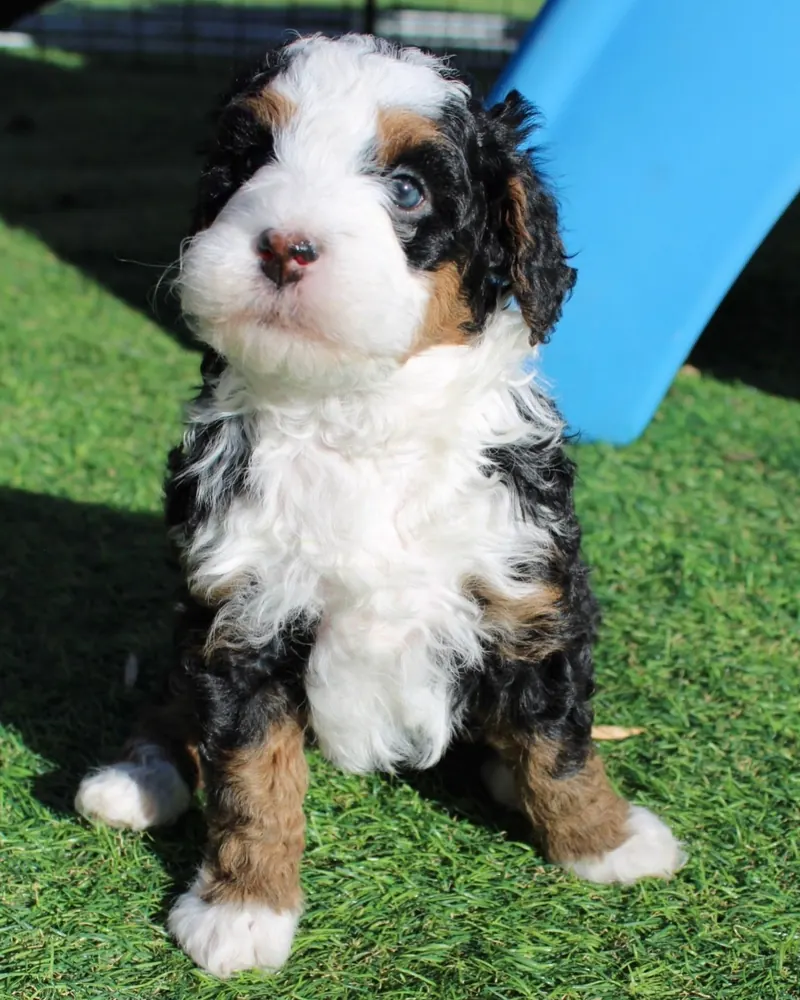 Mini BernedoodlesAbout 25 to 49 poundsLearn more
Bernedoodle Health Problems and Health IssuesCommon Bernedoodle health issues, from hip dysplasia and cancer to eye and skin problems, plus the tests that exist and...Read the guide
 How Long Do Bernedoodles Live?How long do Bernedoodles live? Commonly quoted ranges, what the Bernese and Poodle parents tell us, mini versus standard,...Read the guide
When You Are Ready
Thinking About a Bernedoodle Puppy?
See the puppies available now, or ask us anything about the breed.