
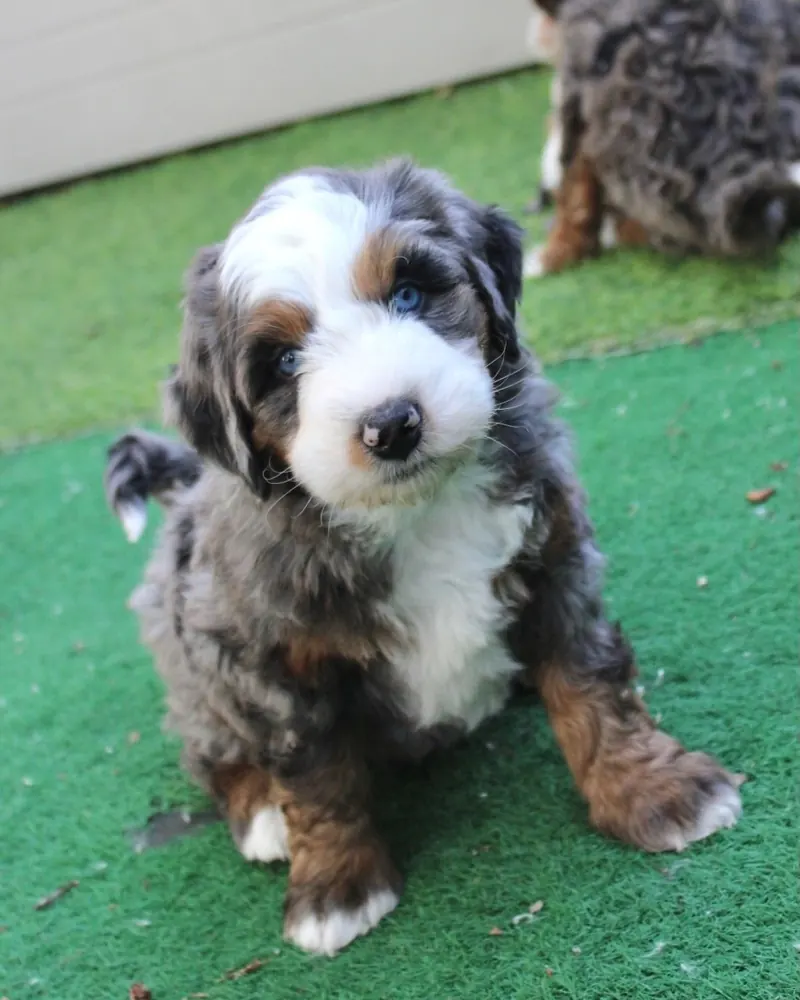
Bernedoodle Guide
Bernedoodle Health Problems and Health Issues
Bernedoodle health issues come from the two parent breeds, so the useful way to understand them is to look at what the Bernese Mountain Dog and the Poodle are each prone to. Many Bernedoodles live active, happy lives, and no study of the cross shows that it is either healthier or less healthy than its parents. What follows is calm, practical information rather than a scare list.
You will find the main conditions, the tests that exist for them, what a mix can and cannot change, and the questions any buyer can put to any breeder. For the age side of the story, see the Bernedoodle lifespan guide, and if you are comparing puppies, the puppies available at KK Doodles are one place to start.
Are Bernedoodles healthy dogs?
Most are, and many reach a good age, but the honest answer is that nobody can promise any individual puppy will stay healthy. The cross is relatively new, long-term studies of Bernedoodles are scarce, so most of what is known is borrowed from the parent breeds.
- The Bernese Mountain Dog is a short-lived giant breed, often cited at about 7 to 10 years, with cancer widely reported as the leading cause of death.
- The Poodle comes in three sizes and is generally longer lived, but has its own inherited conditions.
- Bernedoodle size matters. Smaller dogs of any breed usually face fewer joint and bloat risks than large ones.
The sensible approach is to learn the risks, pick a puppy from screened parents, and keep your own dog lean and regularly checked by a vet.
Does hybrid vigor make Bernedoodles healthier?
Sometimes a little, but not as much as marketing suggests. Crossing two breeds can lower the chance of a puppy inheriting two copies of a recessive disease gene, if the parents carry different problems. That is the real idea behind hybrid vigor.
It has clear limits:
- Conditions both breeds share, such as hip dysplasia, certain eye diseases and von Willebrand disease, are not removed by crossing.
- Many problems, including dysplasia and cancer, involve many genes plus environment, so the cross gives no clear protection.
- Dominant or dose-sensitive conditions can still pass from one parent.
So a Bernedoodle is not automatically healthier than a Bernese or a Poodle. Screening the parents still matters, and so does size.
What is hip and elbow dysplasia in Bernedoodles?
Hip and elbow dysplasia are inherited malformations of the joints that can lead to pain, lameness and arthritis. The Bernese is among the breeds with a high rate of both, and Standard Poodles can be affected as well. Food, growth rate and exercise influence how severe signs become, but genetics sets the stage.
- Signs include bunny-hopping, difficulty rising, stiffness after rest and reluctance to climb stairs.
- Treatment ranges from weight control, joint supplements and physiotherapy to surgery for severe cases.
- Keeping a growing puppy lean, and avoiding forced running and repeated jumping while the joints form, helps.
Feeding matters too. The Bernedoodle food guide covers large-breed puppy food and weight.
Are Bernedoodles prone to cancer?
The Bernese Mountain Dog certainly is. Histiocytic sarcoma, an aggressive cancer, is strongly associated with the breed, and other tumors such as mast cell tumors, lymphoma and osteosarcoma are reported too. Whether the Bernedoodle inherits the same risk, reduced or not, has not been established by large studies.
What you can do:
- Ask what is known about cancer and age of death in the parents and grandparents.
- Check any new lumps with a vet promptly, since early diagnosis helps.
- Understand that a genetic marker-based risk test for histiocytic sarcoma exists for Bernese. The Bernese Mountain Dog Club of America describes it as an estimate of risk, not a diagnosis or a guarantee.
A smaller Poodle share in the mix, or a larger one, does not give you a safe prediction either way.
What is bloat, and are Bernedoodles at risk?
Bloat, or gastric dilatation and volvulus, is when the stomach fills with gas and may twist. It is a life-threatening emergency that mostly affects deep-chested dogs. Bernese and Standard Poodles are both at risk, so standard Bernedoodles should be considered at risk too.
- Signs: swollen or tight belly, retching without producing anything, drooling, restlessness and distress.
- Act immediately. This needs an emergency vet, not waiting overnight.
- Common advice includes feeding smaller meals and avoiding hard exercise right around mealtimes, although the evidence on prevention is mixed.
- Ask your vet whether a preventive stomach tacking procedure at the time of spaying or neutering makes sense for your dog.
Which eye problems affect Bernedoodles?
Both parent breeds have eye conditions. Progressive retinal atrophy, which causes gradual vision loss, affects Poodles, and a DNA test for the common Poodle form exists. Cataracts, eyelid abnormalities and other problems are reported in Bernese. A veterinary ophthalmologist can examine breeding dogs for these, and the exam is repeated regularly because some conditions appear later in life.
The coat plays a part as well. Hair around the eyes can irritate them, and tear staining and infections happen. Your groomer can keep the face trimmed, which the grooming guide explains.
What blood and nerve conditions should buyers know about?
Two inherited conditions are worth knowing by name, because DNA tests exist for both.
- Von Willebrand disease: a bleeding disorder affecting how blood clots. It is reported in both Bernese and Poodles, and genetic tests can show whether a dog is clear, a carrier or affected.
- Degenerative myelopathy: a progressive spinal cord disease that usually appears in older dogs and causes hind limb weakness. A DNA test for the SOD1 variants is recommended for Bernese by their national club.
A clear result in both parents lowers the chance a puppy is affected. A carrier is usually healthy but can pass the gene on, which is why a breeder should know both parents' results before breeding.
What skin, ear and hormone problems occur?
Skin and ears are among the most common reasons Bernedoodles see the vet. Thick, curly coats trap moisture in the ear canal, and allergies or yeast can cause infections. Sebaceous adenitis, an inflammatory skin condition that damages hair follicles, occurs in Poodles, and a skin biopsy is used to diagnose it. Testing in breeding dogs has been described as controversial because results can be inconclusive.
Addison's disease, a hormone disorder where the adrenal glands do not make enough hormones, is recognized in Standard Poodles. Scientists are working on genetic tests, but no widely accepted test exists yet, so it comes down to knowing the family history.
If you are asking whether a Bernedoodle is allergy friendly, that is a separate matter, covered in the guide to shedding and allergies. No dog is free of allergens.
Do blue eyes mean a Bernedoodle has a health problem?
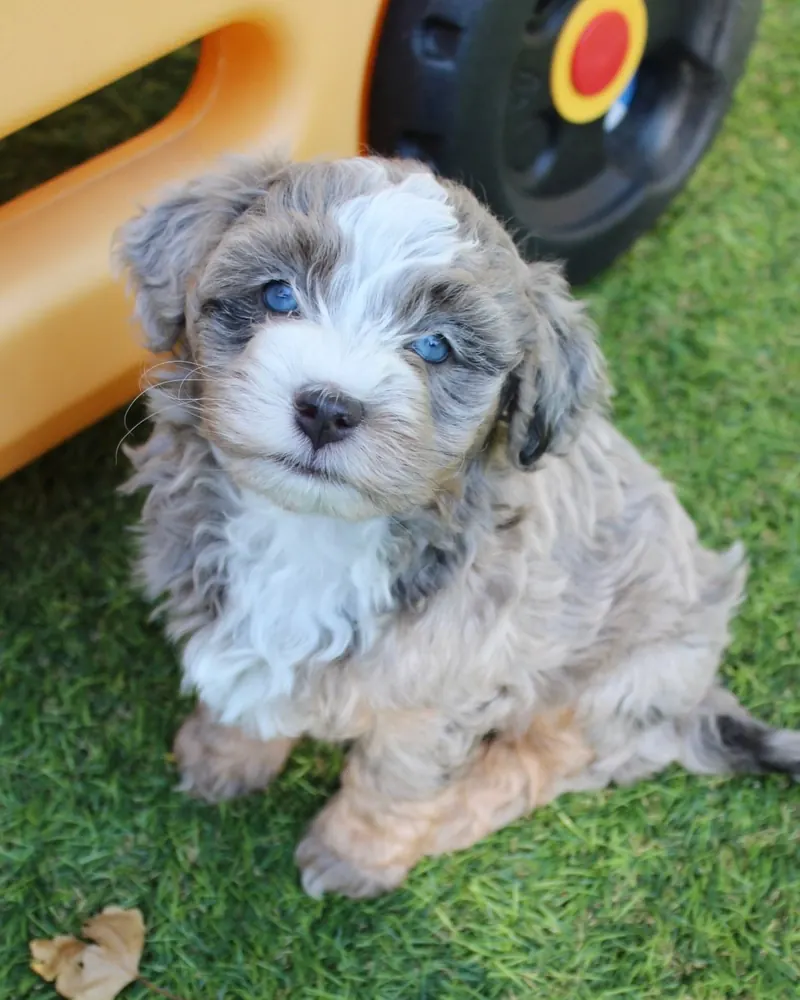
Not by themselves. Blue eyes in a Bernedoodle are most often linked to the merle pattern, which neither Bernese nor Poodles carry in their usual form, so it enters the cross from another breed. A merle dog with blue eyes can be perfectly healthy. The danger is in breeding two merles together, which can produce puppies with serious vision and hearing defects. If you like the look, ask about the parentage. See the merle Bernedoodle page for more.
What tests exist, and what can a buyer ask any breeder?
Several screening tools are available to any breeder, and any buyer is entitled to ask about them.
| Condition | What exists |
|---|---|
| Hips and elbows | OFA radiograph evaluations, or PennHIP for hip laxity |
| Eyes | Exam by a veterinary ophthalmologist, repeated over time |
| Progressive retinal atrophy | DNA test (prcd form in Poodles) |
| Von Willebrand disease | DNA test |
| Degenerative myelopathy | DNA test |
| Histiocytic sarcoma | Marker-based risk test for Bernese |
| Sebaceous adenitis | Skin biopsy, with limits |
Questions worth asking:
- Can I see the written results for both parents, with registry numbers I can check?
- How old are the parents, and how long did the grandparents live and what did they die of?
- What do you do if a puppy develops a serious inherited problem, and what does the contract say?
- Which Poodle size and generation are the parents?
A transparent answer matters more than a perfect one. The Bernedoodle breeders page goes into choosing a breeder.
Quick Answers
01Do mini Bernedoodles have fewer health issues?
They are often expected to, since smaller dogs face fewer joint and bloat risks, but they still carry Poodle and Bernese genes. Screening of the parents matters at every size.
02Can a vet check for these problems in a puppy?
A vet can examine a puppy for obvious problems, but many inherited conditions, such as dysplasia, cannot be confirmed until later. Parent results are more informative.
03Is pet insurance worth it for a Bernedoodle?
Many owners of large breeds choose it because orthopedic surgery and cancer treatment can be costly. Read the exclusions carefully and enroll while the puppy is young.
04When should a Bernedoodle first see a vet?
Within the first few days of coming home, then on the schedule your vet sets for vaccines and checks.
05Do Bernedoodles get ear infections often?
They can, because the coat traps moisture. Dry the ears after baths and swimming and ask your vet or groomer how often to clean and trim them.
Bernedoodle Puppies Available Now
Keep Reading
 How Long Do Bernedoodles Live?How long do Bernedoodles live? Commonly quoted ranges, what the Bernese and Poodle parents tell us, mini versus standard,...Read the guide
What to Feed a Bernedoodle: Food, Amounts and ScheduleThe best food for a Bernedoodle: what to feed puppies and adults by size, how much, a feeding schedule by age, foods to...Read the guide
 Do Bernedoodles Shed?Do Bernedoodles shed? Shedding by generation and coat type, furnished versus unfurnished, and an honest answer on...Read the guide
Bernedoodle Generations: F1, F1b, F2 and MultigenF1, F1b, F1bb, F2, F2b and multigen Bernedoodles explained: what each label means, how it relates to coat and shedding,...Read the guide
Bernedoodle BreedersHow to choose a Bernedoodle breederLearn more
 Bernedoodle Grooming GuideBernedoodle grooming made simple: how to brush and line brush, handle mats, bathe, clean ears and nails, plus teddy bear...Read the guide
When You Are Ready
Thinking About a Bernedoodle Puppy?
See the puppies available now, or ask us anything about the breed.