
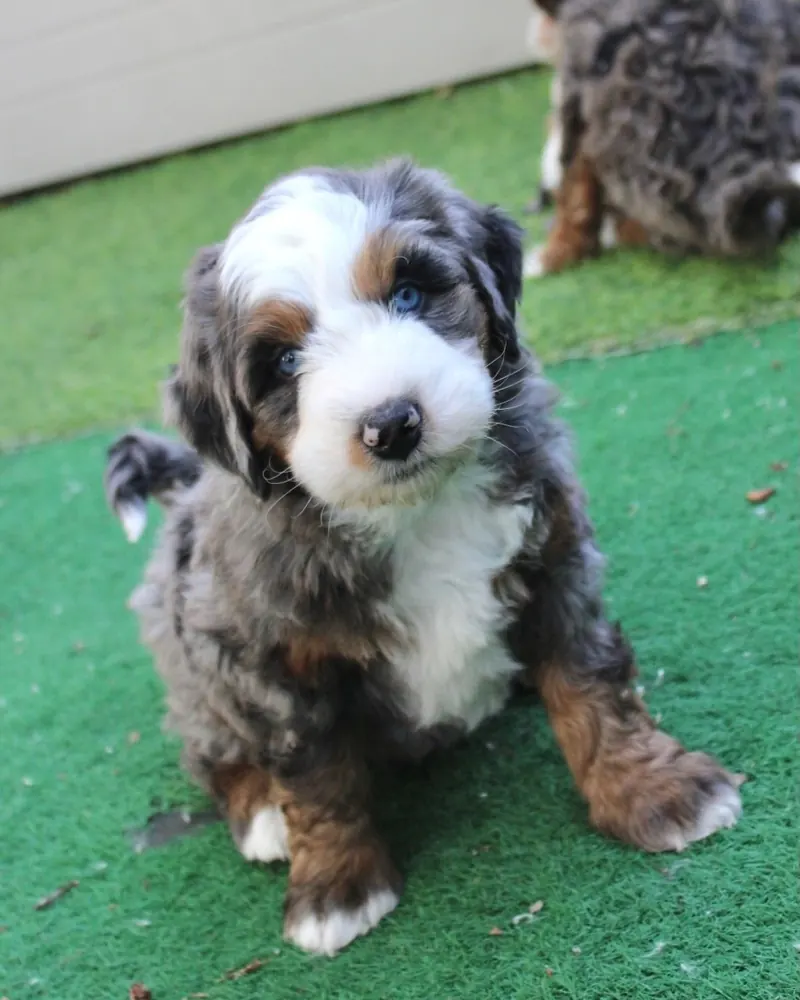
Bernedoodle Guide
How Big Do Bernedoodles Get? Full Grown Size and Weight
A full grown Bernedoodle can weigh anywhere from about 10 pounds to 90 pounds or more. That spread is not a mistake: the cross takes its size from the Poodle parent, which can be a toy, a miniature or a standard, and the Bernese Mountain Dog parent is large in every case.
Below are the usual ranges for each size, a growth chart by age, the point where growth stops and some practical ways to estimate adult size. One caution up front: Bernedoodle sizes are breeder conventions, not breed standards, so the numbers are guides and a particular dog can land outside them.
How big is a full grown Bernedoodle?
Size labels are used loosely, but most breeders group Bernedoodles roughly like this. Treat the ranges as typical, because the edges of each category overlap from one breeder to the next.
| Size | Typical height at the shoulder | Typical adult weight |
|---|---|---|
| Standard | About 23 to 29 inches | Often about 50 to 90 pounds, frequently 70 or more |
| Mini | About 18 to 22 inches | Often about 25 to 49 pounds |
| Toy or tiny | About 12 to 17 inches | Often about 10 to 24 pounds |
Some breeders also sell a "micro" size at the bottom of the range. See the pages for standard, mini, micro and toy Bernedoodles for what each looks like.
Why do Bernedoodle sizes vary so much?
The Bernese side is fixed. According to the American Kennel Club standard, Bernese males measure 25 to 27.5 inches and females 23 to 26 inches, and club sources put adults somewhere between about 70 and 115 pounds. The Poodle side is where the variety comes from, because Poodles are recognized in three sizes: toy at 10 inches or under, miniature over 10 and up to 15 inches, and standard over 15 inches.
A standard Poodle crossed with a Bernese gives the biggest dogs. A miniature Poodle crossed with a Bernese gives the mini. Smaller sizes usually come from breeding a mini Bernedoodle to a smaller Poodle in later generations. Because of this, a Bernedoodle's generation affects the likely size as well, which is covered in the guide to Bernedoodle generations.
How much does a mini Bernedoodle weigh when fully grown?
This is the most asked size question, and the honest answer is a range. Many breeders describe a full grown mini as roughly 25 to 49 pounds and around 18 to 22 inches tall. Within that, a lighter dog from a smaller Poodle parent may finish in the 20s, while one with more Bernese in the mix may reach the upper 40s and sometimes beyond.
If you are buying a mini, ask what the parents weigh now and what their parents weighed. Those adult weights tell you far more than the size label on a listing. Some pairings produce puppies larger than the breeder expected, and the size name on a puppy is a prediction rather than a promise. A dog sold as a mini that matures at 50 pounds is not unheard of, so plan your crate, car and home with a margin. Micro and toy sizes are even harder to predict, since they sit at the edge of what the cross produces, and the smallest dogs can be more fragile as puppies. The micro Bernedoodle page explains what to look for.
What is a Bernedoodle growth chart by age?
There is no official growth chart for the cross, so the table below is a rule of thumb: the rough share of final weight a puppy has reached at each age. Individual puppies grow in bursts, and males, females and different sizes track differently. Use it as a loose guide, not a measurement.
| Age | Rough share of adult weight |
|---|---|
| 8 weeks | About one fifth to one quarter |
| 4 months | About half |
| 6 months | About two thirds to three quarters |
| 9 months | About 85 percent |
| 12 months | About 90 to 95 percent |
| 18 to 24 months | Close to full weight |
Standards usually lag behind the smaller sizes at every step. A dog expected to weigh 80 pounds will still be adding mass at two years, while a toy may be close to done by ten months.
When do Bernedoodles stop growing?
Height comes first. Smaller Bernedoodles often reach nearly their full height by around 9 to 12 months, and standards by around 12 to 15 months. After that, the dog fills out: the chest deepens, the body broadens and muscle builds. Large and giant dogs generally keep filling out until about two years of age, and the Bernese heritage means standards often follow that pattern.
Coat can fool you. A fluffy teenager looks bigger than the scales say, and a freshly clipped dog looks smaller. Judge growth by weight and height, not by how much fur is in the photo.
How tall is a Bernedoodle?
Height is measured from the ground to the highest point of the shoulders, called the withers. The typical ranges in the table above are the same ones breeders and vets commonly use. A mini that measures 21 inches at the shoulder is normal, and a standard at 26 inches is squarely in the expected range.
Weight is best judged by body condition, and asking your vet to show you what an ideal score feels like is a useful lesson. Remember that height and weight do not always rise together. A lean, leggy Bernedoodle and a stocky one can be the same height with very different weights. If your dog is at a healthy weight you can feel the ribs under a light covering of flesh and see a waist from above, whatever the number on the scale.
How can you estimate a puppy's adult size?
No method is exact, but a few checks narrow the guess:
- The parents: the weight and height of both parents, and ideally of their parents, is the best single indicator.
- Weight at 16 weeks: many owners double the weight of a small or medium puppy at about four months for a rough adult estimate. For standards the multiplier is usually higher, since large puppies are slower to fill out.
- Weight at 6 months: roughly two thirds to three quarters of final weight is a common rule of thumb.
- Paw size and leg length: big paws on a young puppy sometimes hint at a big dog, but this is unreliable on its own.
- Your vet: a vet who weighs the puppy at each checkup can plot the curve against the expected pattern.
If size matters a great deal to you, such as for an apartment, a car or a travel crate, choose a size and generation with a record of consistent adults and keep a margin for error.
Does the generation or the coat change a Bernedoodle's size?
A little. A first cross takes its size from two very different parents, so littermates can finish at different weights. Later generations, especially multigen lines that have been selected for size, can be more consistent, though a litter bred from mixed sizes can still vary. Coat type does not affect skeleton size, but a thick wavy coat does make the same dog look bigger than a closely clipped one.
Color has no direct effect on size either, so a merle, a tricolor and a sable of the same breeding can be equal in height and weight. What does matter is the individual line: some families of dogs run large for their size label, and a breeder who has raised several litters from the same parents can tell you how their puppies finished. Ask for adult photos and weights of past puppies if the breeder has them.
How does size affect food, health and lifespan?
Bigger dogs eat more, cost more to medicate and tend to have shorter lives. Standards carry more risk of joint problems and of bloat, a serious stomach condition seen in deep-chested dogs, while smaller Bernedoodles are generally expected to live longer. The Bernedoodle lifespan guide and the Bernedoodle food guide go further into these points.
To see what is currently on offer in each size, look at the puppies available at KK Doodles on the available puppies page.
Quick Answers
01What is the smallest Bernedoodle?
The smallest are sold as toy, tiny or micro Bernedoodles, often in the 10 to 24 pound range. Those names are breeder conventions rather than official sizes, so ask for parent weights.
02Can you predict how big a puppy will get from its paws?
Only loosely. Large paws on a young puppy can suggest a larger dog, but the parents' size and the puppy's weight at several ages are better guides.
03Do female Bernedoodles stay smaller than males?
Often, yes. Females usually finish a little lighter and shorter than males of the same litter, though the difference varies and some females outgrow their brothers.
04Is a standard Bernedoodle bigger than a Bernese Mountain Dog?
Usually not. Standard Bernedoodles commonly come out somewhat smaller or lighter than a purebred Bernese, though a large dog from a large standard Poodle can match one.
05Will my Bernedoodle get any bigger after one year?
Yes, in most cases. Height is mostly done, but weight and chest depth keep building, especially in standards, until around two years.
Bernedoodle Puppies Available Now
Keep Reading
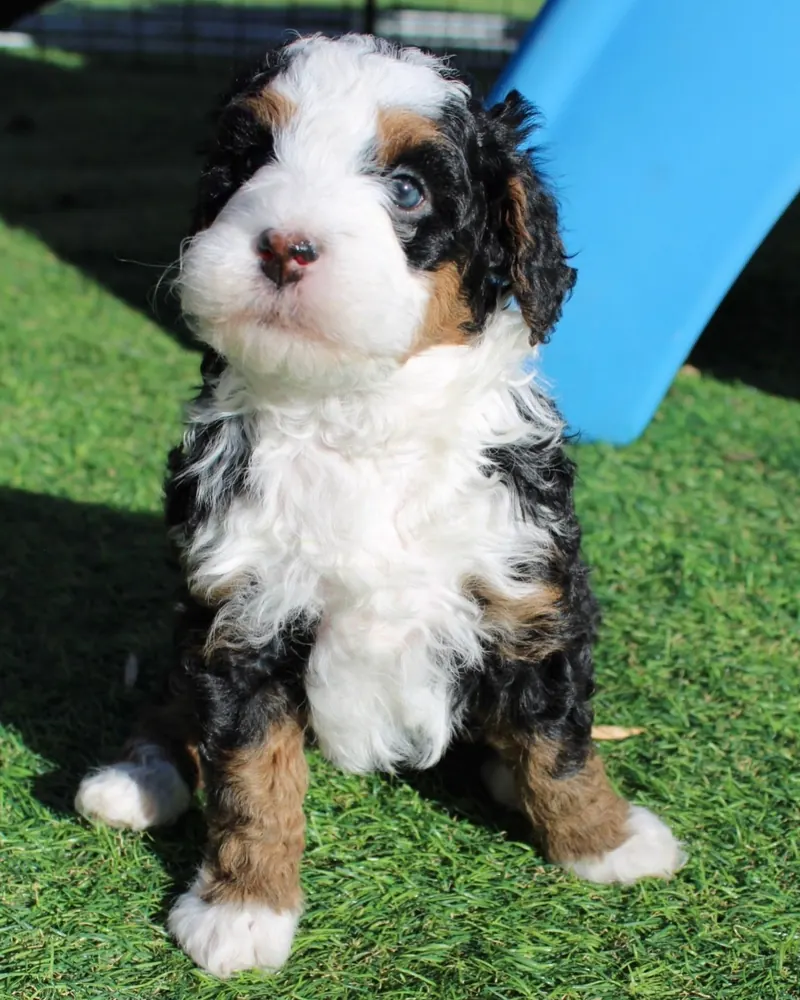 Mini BernedoodlesAbout 25 to 49 poundsLearn more
Standard BernedoodlesThe original, largest sizeLearn more
Bernedoodle Generations: F1, F1b, F2 and MultigenF1, F1b, F1bb, F2, F2b and multigen Bernedoodles explained: what each label means, how it relates to coat and shedding,...Read the guide
How Long Do Bernedoodles Live?How long do Bernedoodles live? Commonly quoted ranges, what the Bernese and Poodle parents tell us, mini versus standard,...Read the guide
 What to Feed a Bernedoodle: Food, Amounts and ScheduleThe best food for a Bernedoodle: what to feed puppies and adults by size, how much, a feeding schedule by age, foods to...Read the guide
 What Is a Bernedoodle?What is a Bernedoodle? A plain-English look at this Bernese Mountain Dog and Poodle cross: where it came from, sizes,...Read the guide
When You Are Ready
Thinking About a Bernedoodle Puppy?
See the puppies available now, or ask us anything about the breed.